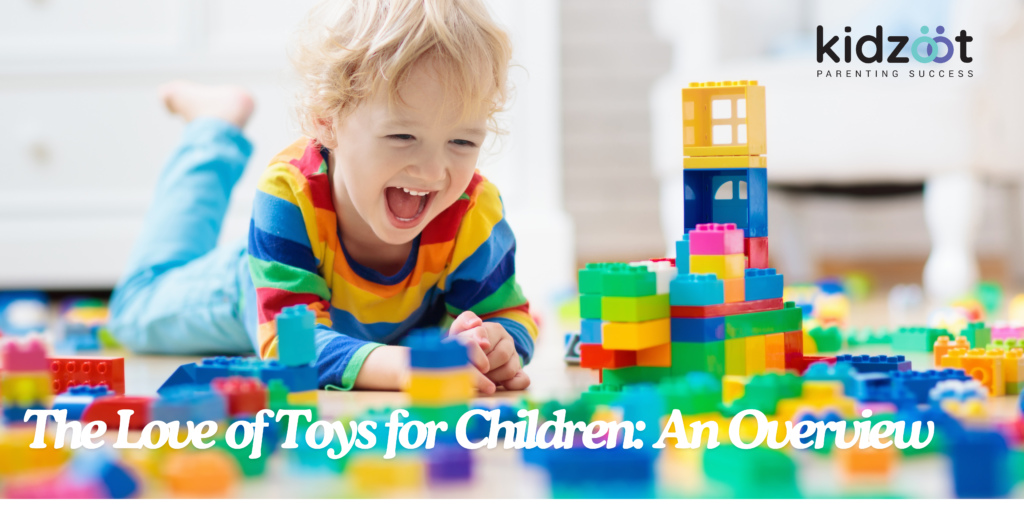
Have you ever thought about what a 3-year-old does with a simple cardboard box? The expensive gift inside is left to the side, and that box becomes a rocket 🚀, a shop, or a tunnel. Every holiday season, parents watch this and laugh. But what is happening in that moment is bigger than your imagination. The child’s brain is working at full speed, new neural connections are forming in their brain, they are learning to understand emotions, and they are preparing for their life ahead.
Toys have always been a precious part of children’s lives. But how did they become so important? Understanding this secret has now become quite easy, especially because of the latest research today. If you are a parent who stands confused in a toy store with your children, wondering what will be right for them, then you have come to the right place — this blog will change your perspective.
Toys are not just a pastime, but for children they are the re-engineering of the brain. Today science has made many things clear. Let us look at some research that is also quite interesting. Neuroscientist Sergio Pellis studied the effect of play on the brain for decades. His work tells us that free play — that is, unguided play done without disturbance or rules — literally changes the structure of children’s brains. It strengthens the neural connections of the prefrontal cortex, which is responsible for decision making, emotional control, and problem solving. Children who play freely have a more adaptive brain, meaning that child can adapt more quickly in newer and newer situations.
Think about this practically once. When your child builds a tower of blocks and it falls, and they try to build it again — this is not just frustration, but it is also the real-time construction of their prefrontal cortex, the brain.
One study has proven that innovative toy design improves both children’s attention span and creative thinking, and also brings a big change in language development and logical reasoning. But not only fancy high-tech toys — if you are a little wise and can make your children experiment or do questionable play with some toys, it can give the same results. Meaning, parents who have a lower budget should get something for their children that allows varied thinking and remaking again and again.
The Learning Hidden Inside the Toy Box
Honestly, I never really thought about how much my kid was learning until I just sat and watched one afternoon. Like, really watched. And it hit me — every single thing they were doing had a purpose.
When kids play with puzzles or build something with blocks, they are quietly teaching themselves how to think ahead, how to remember steps, how to figure things out. That stuff shows up later in school, and you will wonder where it came from. It came from the playroom floor.
Motor skills are the same story. Every time a little one picks up a toy, stacks something, or tries to fit a shape into a hole — their hands and eyes are learning to work together. It seems small. It is not small. That coordination is what helps them hold a pencil years later.
And the emotional stuff? That is the part I find most fascinating. When a child gives a doll a name, argues with a stuffed animal, or acts out a whole pretend doctor visit — they are processing feelings. They are practising how to be a person. Role-play is basically therapy, but make it fun.
Language sneaks in too, especially when you are nearby. Not teaching, not correcting — just present. Kids narrate, they explain, they make up stories. That is vocabulary happening in real time, and it sticks in a way that no learning app can replicate.
| Cognitive Growth | 🧩 | Puzzles & blocks teach planning, memory & logical thinking |
| Motor Skills | ✋ | Grasping, stacking & fitting shapes builds hand-eye coordination |
| Emotional Intelligence | 🫶 | Dolls & role-play help kids understand feelings & empathy |
| Language | 💬 | Storytelling & narrating play builds vocabulary naturally |
| Social Skills | 👫 | Group play teaches turn-taking, sharing & conflict resolution |
Guided Play vs. Free Play: Which One Is Better?
Every parent I know has asked this at some point. Do I sit down and play with them? Do I just let them go? Am I doing it wrong either way?
Here is what I have come to understand — both matter, just differently.
Structured play, the kind with rules and goals, teaches kids that the world has expectations. Board games teach them to wait their turn. Team sports teach them that other people matter too. There is real value in that.
But free play — where they decide everything — is where something deeper happens. When no one is telling them what to do, they figure things out on their own. They mess up, they fix it, they keep going. That quiet confidence? That is built during free play, not during any class or lesson.
What surprised me most is that kids who get more free play time tend to handle hard moments better as they get older. Because their brain has already practised dealing with the unexpected. The best thing you can do some days is just put your phone down and let them figure it out.
The Era of Open-Ended Toys Has Arrived
Go into any good toy shop now and something feels different. Less noise. Less plastic. More wood, more art supplies, more things that just… sit there waiting for a child’s imagination to do the work.
And honestly? Those are the toys that last. I have seen a simple set of wooden blocks become a castle, a city, a farm, and a spaceship — all in the same week. The toy never changed. The kid did.
There is something beautiful about a toy that does not tell your child what to do with it. It is an open invitation. The child brings everything — the story, the rules, the world. That is where real creativity lives.
✅ The 5-Second Toy Test
Points:
🔄 Can it be used more than one way? → Open-ended = longer engagement
😤 Is it slightly challenging? → A little hard = a lot of learning
🙌 Does it involve their hands? → Physical interaction builds motor skills
👀 Will they come back to it tomorrow? → Replay value = real developmental worth
🔇 Does it work without batteries? → Quiet toys invite louder imaginations
Smart Toys, Sustainability, and What Is Coming Next
The toy world is genuinely changing in exciting ways. STEM kits and coding toys for little kids are not as intimidating as they sound — at their core, they just teach kids to ask “what happens if I try this?” That curiosity is everything.
Sustainable toys are also having a real moment, and not just for environmental reasons. Wood and natural materials just feel better. They last longer. There is something grounding about a toy that is not made of cheap plastic that breaks in a week.
AR toys are wild and kind of magical when done right. Watching a child point a tablet at a toy and see it come alive in 3D — that is not replacing imagination, it is adding fuel to it.
What Parents Want — And What Kids Actually Need
Most of us go into a toy store with good intentions. We want something educational, something that will do something for our kids. And that instinct is right.
But I think the gap a lot of us fall into is believing that the more we spend, or the more features a toy has, the better it is. That is almost never true.
The best toy is the one your child keeps coming back to. The one they pick up when they are bored and you have not suggested anything. That toy does not need batteries. It just needs to be good enough to hold their attention and open enough to let their mind wander.
And here is the thing nobody tells you enough — you matter more than the toy. Just being in the room, just being available, just occasionally asking “what are you building?” — that changes the quality of play entirely.
🗓️ Right Toy, Right Time
| Age | Best Toy Type | Why |
|---|---|---|
| 0–12 months | Soft toys, rattles, sensory balls | Stimulates senses, builds grip |
| 1–2 years | Stacking rings, shape sorters, push toys | Fine motor + cause & effect |
| 2–3 years | Play dough, blocks, simple puzzles | Creativity + problem solving |
| 3–5 years | Role-play sets, art supplies, basic building kits | Language + imagination |
| 5–7 years | Board games, STEM kits, outdoor toys | Logic + social skills |
| 7+ years | Strategy games, science kits, craft sets | Critical thinking + independence |
A Few Tips for Choosing Toys With Intention
If you are trying to be more thoughtful about what you bring home, these are the things that actually work:
Buy less, but buy better. Fewer good toys beat a pile of forgettable ones every time.
Ask if it can be used more than one way. If yes, it is worth it.
Let it be slightly challenging. Easy is boring. A little bit hard is motivating.
Do not skip physical play. Outdoor toys, balls, things that get kids moving — these matter more than we give them credit for.
Trust the boring classics. Blocks, crayons, play dough. They have been around forever for a reason.
A Toy Is Never Just a Toy
There is this moment every parent knows — you watch your kid completely lost in play. Talking to their toys, building something, rearranging the same five figurines for the fourteenth time. And if you are paying attention, you realize you are watching them figure out life.
They are learning what feelings are. They are learning what stories sound like. They are learning that when something does not work, you try again.
Toys are not a distraction from childhood. They are childhood. And the next time your kid disappears into a corner with a cardboard box and comes back forty minutes later having built an entire universe — let them stay a little longer. That world they built is real to them. And that makes it worth everything.
![Picture of Abhishek Sonkar [Author]](https://kidzoot.com/wp-content/uploads/2023/07/Front-photo-for-Website-300x300.webp)
Abhishek Sonkar [Author]
Meet Abhishek Sonkar, [B.com, B.Ed., M.Ed.], a child development specialist with years of experience in the field. He has written numerous blog posts on child development and parenting.